Massive Stars in the Tarantula Nebula in the Large Magellanic Cloud. Image credit: ESO / the Visible MultiObject Spectrograph (VIMOS) at the VLT.

About Me
I have studied Physics and Astronomy at the University of Hamburg (Germany). My Master thesis I have done at the INTEGRAL Science Data Center in Geneva (Switzerland). Next I moved on to the University of Utrecht (Netherlands) where I obtained my PhD. Now I am based at the University of Vienna, working as a University Assistant (Postdoc).
Contact Details
Ines Brott
Türkenschanzstr. 17
1190 Vienna, Austria
Massive Stars
With masses of ~5-100 times the mass of the sun, massive stars live a very rapid and influential life. As cosmic engines they synthesis the elements we are all made of and distribute these in the universe through strong stellar winds during their life and in spectacular supernova explosions in their dead.
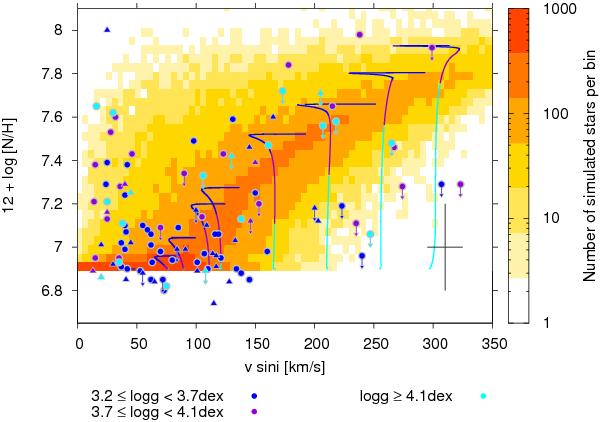
During their Hydrogen burning lifetime, massive stars show very different amount of Nitrogen and Helium on their surface, but often much larger amounts than found in the sun. These elements are synthesized in their cores, but unclear how they are transported to the surface while the star is still on the main sequence. Rotation, indicated by high surface velocities of most massive stars seems to be a key, but many questions remain. I am studying this problem using stellar evolution models including the theory of rotational mixing.
Download Tracks and Isochrones
Evolutionary track and isochrones of rotating stars, published in Brott et. al 2011a can be downloaded here . Please contact me, if questions arise.
 s
s3D simulations of protoplanetary disks
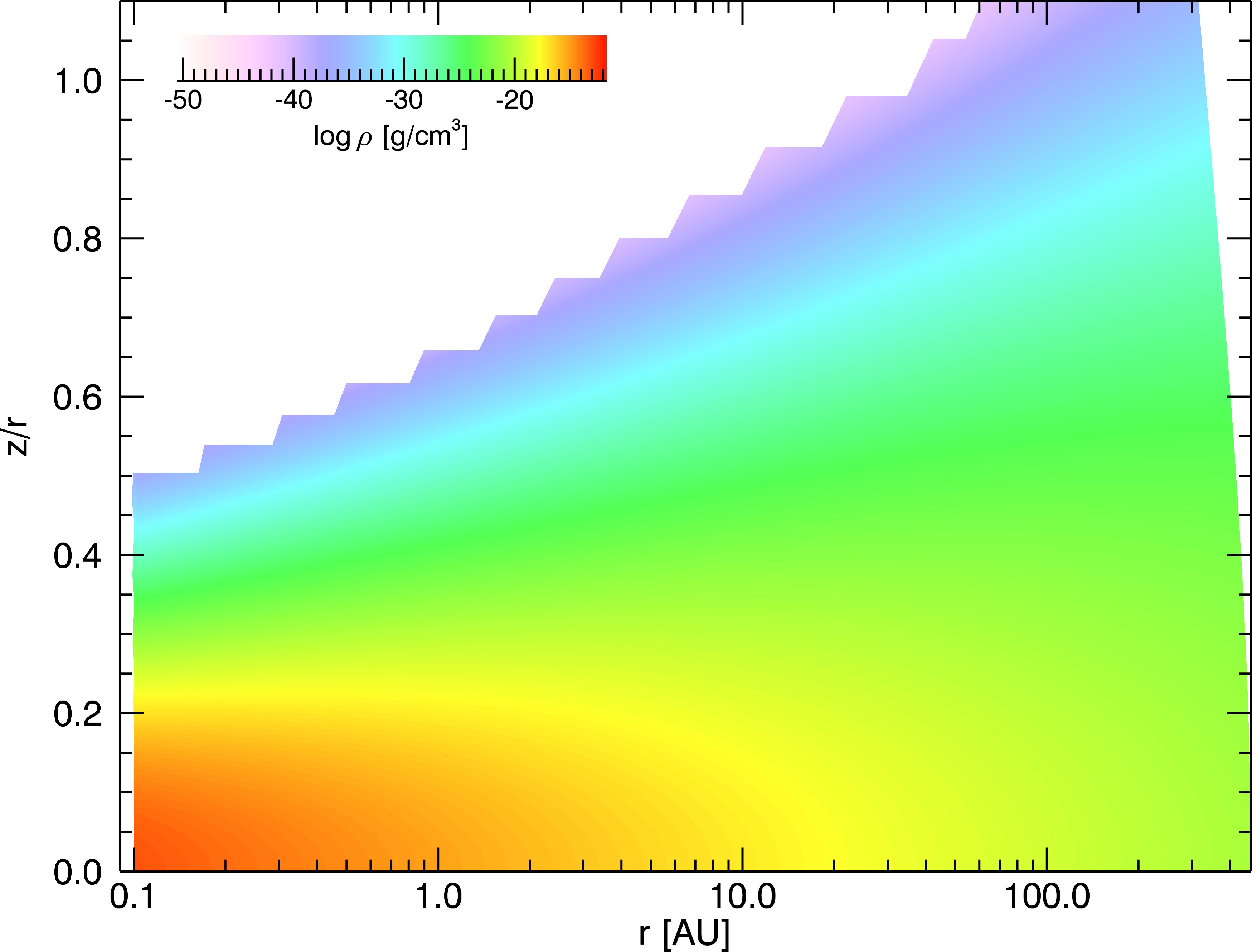
Models of protoplanetary disks are usually calculated in 1+1D approximations, meaning the disc is approximated as 1D slices. While much progress has been achieved with these kind of models, real disks are 3D. Planet formation is suspected to cause non-systemic structures in discs, which can only be modeled in 3D.Based on the 3D radiative transfer environment PHOENIX/3D, we are developing a new code to simulate protoplanetary discs in 3D and study the effects planet formation has on them.
Publications
The Astronomical data service keeps track of publications in the field of Astronomy and Astrophysics. A list of my papers can be found here.
Press releases
VLT Flames Survey of massive stars related press release
- NOVA press release, Snelle rotatie niet alleen bepalend voor mengproces in zware sterren , 7. April 2008
VLT Flames Tarantula survey related press relases
- A&A higlight, The VLT-FLAMES Tarantula Survey. II. R139 revealed as a massive binary system 20. Mai 2011
- News articles due to R102 paper
- Nova press release Snelst draaiende ster ontdekt , 2. Dez. 2011
- ESO press release, VLT Finds Fastest Rotating Star,5. Dez. 2011
- Corriere de la Sera, Ecco la stella dei record : gira su di sé a 600 km al secondo , 5. Dez. 2011
- Hubble press release, Fastest Rotating Star Found in Neighboring Galaxy , 5. Dez. 2011
- UCSB, UCSB Scientist Contributes to Discovery of the Fastest-Rotating Massive Star Ever Recorded , 5. Dez. 2011
- Die Krone, Bislang schnellster rotierender Stern entdeckt, 6. Dez. 2011
- Die Welt, Superheller Hochgeschwindigkeits-Stern entdeckt, 6. Dez. 2011
- Spektrum, Stern rotiert rekordverdächtig ,8. Dez. 2011
- Bulgarian NAO release, 9. Dez. 2011
- Der Standart Stern mit bewegter Geschichte steht kurz davor, zerrissen zu werden, 10.Dez. 2011
- AAS podcast, The fastes spinning star,20. Dez. 2011
- Die Presse, Ein Stern, der rassend rotiert wie kein zweiter , 2 Jan 2012
- FAZ, Ausreißer mit Speed,2. Jan 2012
Teaching
Courses taught at the University of Vienna
- Sterne & Planeten
- summer term 2011
- summer term 2013
- summer term 2015
- Übungen zu Sterne & Planeten
- summer term 2011
- summer term 2013
- summer term 2015
- Bacheor Seminar
- winter term 2011/12
- winter term 2012/13
- winter term 2013/14
- winter term 2015/16
- Übungen zu Einführung in die Astronomie
II
- summer term 2012